
Study in Canada: Your gateway to Permanent Residency
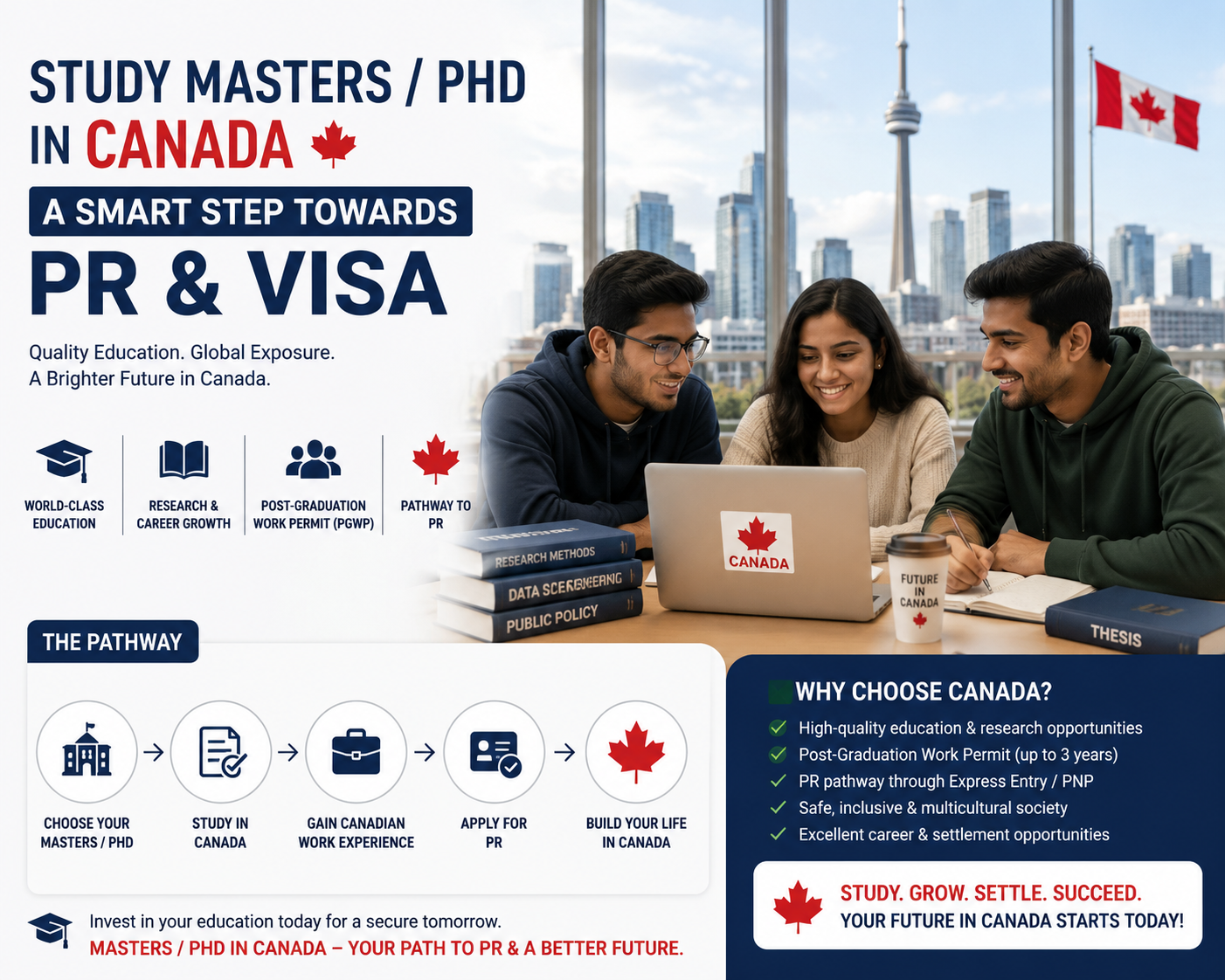
If you're an Indian student planning to pursue a Master’s or PhD in Canada, your focus is likely on admissions, SOPs, and scholarships. But here’s the reality most students overlook:
Your study plan and PR (Permanent Residency) strategy must be aligned from day one.
Why Studying in Canada Gives You a PR Advantage?
Canada’s immigration system rewards candidates with Canadian education and work experience. This gives international students a clear edge.
Post-Graduation Work Permit (PGWP)
After completing an eligible program, you can apply for a Post-Graduation Work Permit, allowing you to:
1. Work full-time in Canada
2. Gain skilled experience
3. Build eligibility for PR pathways
Stronger Express Entry Profile
Canadian education and work experience significantly boost your profile under Express Entry. This helps you qualify for:
1. Canadian Experience Class (CEC)
2. Provincial Nominee Programs (PNPs)
Additional CRS Points
A Canadian degree improves your Comprehensive Ranking System (CRS) score — making it easier to receive an Invitation to Apply (ITA).
Access to Provincial Nominee Programs (PNPs)
Many provinces have dedicated immigration streams for international graduates, often with lower eligibility barriers.
The Truth: PR Is Not Automatic
Studying in Canada does NOT guarantee PR. It gives you a structured and achievable pathway.
To successfully transition to PR, you typically need:
(i) At least 1 year of skilled work experience (for CEC)
(ii) Strong language scores (IELTS/CELPIP)
(iii) A competitive CRS score
Your Step-by-Step PR Pathway
Step 1: Choose the Right Program
(a) Your PR journey starts here.
(b) Select PGWP-eligible programs
(c) Align your field with in-demand occupations
(d) Choose provinces with strong PNP options
Step 2: Gain Canadian Work Experience
(a) Work part-time during studies (as permitted)
(b) Apply for PGWP after graduation
(c) Secure full-time skilled employment
Step 3: Apply Through Express Entry
Create your profile under Express Entry and optimize your CRS score.
Step 4: Leverage Provincial Nominee Programs
Apply to provinces that prioritize international graduates to increase your PR chances.
When Should You Start PR Planning?
It would be most beneficial to begin your PR-planning before applying to universities in Canada. Early planning allows you to:
1. Choose the right course and location
2. Align your career with immigration pathways
3. Avoid delays and missed opportunities
Common queries of Graduate students:
1. Do I need a job offer to apply for PR?
No. A job offer is not mandatory under Express Entry, but it can improve your CRS score.
2. Do I need to live in Canada before applying for PR?
It depends: CEC requires at least 1 year of skilled work experience in Canada.
In other programs, you can apply from outside Canada as well.
3. How long does it take to get PR after graduation?
The typical timeline is 1–3 years to gain relevant work experience, and around ~6–8 months for PR processing after ITA.
4. Is a Master’s or PhD better for PR?
Master’s is a faster, more common route. Whereas, PhD offers additional academic and research-based opportunities.
Common Mistakes to Avoid:
(i) Choosing programs not eligible for PGWP
(ii) Ignoring job market demand
(iii) Delaying PR planning until after graduation
(iv) Not preparing for language tests early
If your goal is Canada PR, your journey doesn’t start after graduation—it starts before you even apply to study.
Start Your PR Journey the Right Way
Amica Immigrations India helps students build a clear study-to-PR roadmap for Canada. We guide you on:
1. Course and province selection
2. PR pathway alignment
3. Express Entry profile optimization
Tap on the link below to book your free consultation today and learn more.